
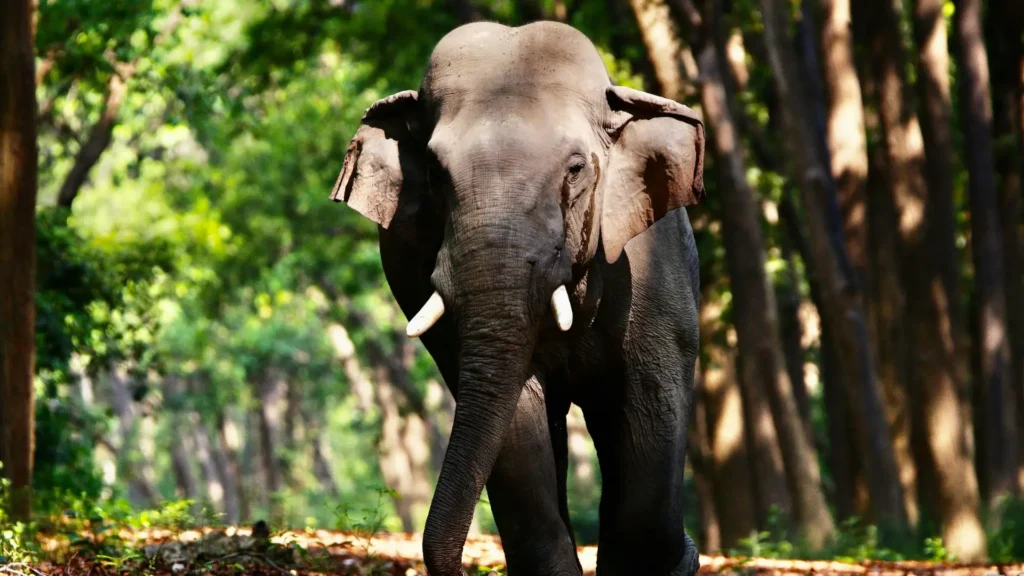
In the quiet dawns of India’s forests, vast beasts tread ancient paths that few of us ever see. These are the hidden arteries of the wild: elephant corridors, narrow strips of habitat that link large forest or grassland patches and allow elephants to move, forage, socialize, and maintain genetic connectivity. As human footprints expand outward, these corridors have become lifelines and battlegrounds.
In 2023, the Ministry of Environment, Forest and Climate Change (MoEF&CC) released a landmark document: Elephant Corridors of India 2023, a report that ground-validates 150 elephant corridors across 15 states. This is more than an updated mapping; it is a call for renewed urgency in protecting the hidden routes of India’s largest terrestrial mammal.
In this blog, we explore:
- Why elephant corridors matter
- What the 2023 report reveals
- The challenges corridors face
- Case studies of corridors under threat
- Strategies and hope for conserving these vital links

Why Elephant Corridors Matter
Ecological connectivity and genetic health
Elephants are wide-ranging animals. In a fragmented landscape, smaller patches of forest become ecological “islands” and isolated populations of elephants risk genetic bottlenecks, reduced resilience, and eventual decline. Corridors provide movement routes that help keep populations connected, allow gene flow, access to seasonal resources, and, when needed, escape from local disturbances.
Reducing human–elephant conflict
When elephants cannot move freely through safe corridors, they may traverse human-dominated landscapes, farmland, villages, roads in search of food or water. Crop raiding, property damage, and in worst cases, loss of life on both sides become all too common. A well-maintained corridor can channel elephant movement through safer zones, reducing confrontations.
Maintaining ecological balance
Elephants are keystone species. Their movement shapes vegetation patterns, disperses seeds, and influences the structure of forests and grasslands. Corridors help extend that influence across landscapes and prevent localized ecological degradation.
Legal, ethical, and policy dimensions
India has recognized the need to preserve such corridors. The Supreme Court has upheld the authority to notify corridors for protection. The Elephant Corridors 2023 report is part of a broader effort under Project Elephant to institutionalize corridor conservation as a national priority.

What the 2023 Report Reveals
The Elephant Corridors of India 2023 report, prepared under Project Elephant and the Wildlife Institute of India, is a landmark assessment. Key findings of the report are:
-
150 corridors ground-validated
The report acknowledges that these mapped corridors represent a minimum set; new data may expand or refine this list further.
-
Expansion of mapped corridors
Earlier assessments (e.g. “Right of Passage,” 2005) had identified around 88 corridors. The 2023 effort added ~62 new corridors, bringing the total to 150.
-
Geographic distribution
These corridors are spread across 15 elephant-range states: Andhra Pradesh, Arunachal Pradesh, Assam, Bihar, Chhattisgarh, Jharkhand, Karnataka, Kerala, Meghalaya, Nagaland, Odisha, Tamil Nadu, Uttarakhand, Uttar Pradesh, and West Bengal.
- Of these corridors, about 126 (84%) lie entirely within one state, while 19 (≈13%) are interstate corridors.
- A few transnational corridors (India–Nepal) are recognized.
-
Usage trends
The report notes varied trends:

-
Regional breakdown
-
India’s elephant range is often divided into four macro-regions:
- Northeast
- East-Central
- Southern
- Northern
The East-Central region has the highest number of corridors (~52), followed by Northeast (~48), Southern (~32), and Northern (~18).
-
Elephant reserves and overlap
Alongside corridors, the government has notified 33 Elephant Reserves in 14 states, covering critical habitats and overlapping with existing protected areas (e.g. tiger reserves, wildlife sanctuaries).
These designated reserves and corridors together aim to provide a more cohesive conservation framework. -
State-wise highlights
- West Bengal has the highest number of corridors (26) about 17% of all corridors.
- Karnataka, Kerala, Tamil Nadu, Assam, and Odisha are among states with multiple corridors and complex landscapes where corridors are vital.
- Newly recognized corridors now allow states with marginal elephant populations (e.g., Bihar) to be part of this national network.
Thus, the 2023 report provides both breadth and depth: mapping, trend analysis, and a blueprint for future work.
Challenges Facing Elephant Corridors
Corridors are fragile constructs, ecologically, socially, legally. Here are the key challenges:

Habitat fragmentation & land conversion
Forests are increasingly fragmented by agriculture, plantations, roads, railways, mines, dams, and urban sprawl. Even a narrow corridor can be severed by a highway or railway line, making it unusable by elephants.
Encroachment and human settlement
Many corridors pass through or adjacent to villages and agricultural lands. Encroachments legally or illegally complicate conservation action. Sometimes, people have lived in or used those lands for generations, raising questions of rights, compensation, and resettlement.
Infrastructure and linear developments
Roads, railways, power lines, pipelines, and canals often bisect corridors. Without proper mitigation, such linear infrastructure becomes barriers and sources of mortality (e.g. train collisions). For example, the Chamarajanagar–Talamalai (Muddahalli) corridor in Karnataka is under pressure, and the 2023 report supports securing land for it.
Governance, overlapping jurisdiction & coordination
Corridors often span multiple administrative units — forest divisions, districts, states. Coordinated action is hard. Also, responsibility lies with state governments, but funding, policy, and technical support often come from central agencies
Legal ambiguities
Corridors are not always clearly defined or legally protected. The 2023 report notes that the mapped corridors are approximate and do not delineate exact boundaries — that must come later via collaborative field studies. Critics argue that earlier corridor listings such as the Right of Passage (2005) lacked robust working definitions and context-specific validation.
Restoration and ecological integrity
Even when corridors are intact in name, their ecological function may be compromised — degraded vegetation, weed invasion, reduced water availability, lack of cover. Some corridors need restoration before they become functional again.
Human–elephant conflict & social resistance
Local communities may view corridor designation as a threat to their land, crops, or safety. Without incentives, compensation, and trust-building, projects can face resistance. Also, elephants passing near villages still pose risk, and conflict mitigation must accompany corridor protection.
Resource and capacity constraints
Many state forest departments lack enough manpower, funding, GIS capacity or monitoring infrastructure to maintain corridors and enforce protections.

Case Studies: Where Elephant Corridors Are Under Threat
Let’s look at a few illustrative examples to ground this discussion.
Jamui–Jhajha–Chakayi (Bihar) — A nascent corridor
In 2023, the Jamui–Jhajha–Chakayi forest stretch in Bihar was included in the national corridor list. Spanning ~46 km in length and 30–50 m in width, it links forest patches across diverse habitats.
Currently, nine elephants use the corridor. Its land use includes ~80 hectares of forest, ~34 hectares of agriculture, and ~10 hectares of human habitation. Challenges include fragmented use, narrow width, proximity to farmland, and infrastructure impeding free movement. Strengthening this corridor can serve as a model for emerging elephant states.
Chamarajanagar – Talamalai (Karnataka)
A corridor under threat of conversion and infrastructure development. The 2023 report advocates for securing land and restoring connectivity here.
This corridor is especially significant because it connects parts of the Nilgiri–Brahmagiri–Eastern Ghats mosaic, which is a biodiversity hotspot.
Chilla – Motichur (Uttarakhand)
In the Rajaji landscape, the Chilla–Motichur corridor connects separate forest blocks. It is often cited in corridors literature, though in the 2023 report its status, challenges, and management prescriptions are updated.
Nilambur – Gudalur corridor (Kerala / Tamil Nadu)
This corridor links the Nilambur forests of Kerala with the Mudumalai–Bandipur landscape of Tamil Nadu. It is weak in width at places, intersected by roads, plantations, and human habitations.
For instance, the Appankappu corridor is only ~0.4 km long and ~0.4 km wide but is cut by residential areas and a road segment.
The broader cross-border corridor of ~35 km along Kerala–Tamil Nadu border is extremely narrow (~0.1 km wide at some stretches), making it vulnerable.
Strategies & Hope: How to Conserve Elephant Corridors
To safeguard these hidden pathways, a multi-pronged, collaborative strategy is essential. Here are key levers:
1. Field-based delineation and mapping
The 2023 report itself cautions that corridor boundaries are indicative; detailed ground-level studies, GPS telemetry, occupancy surveys, and participatory mapping must refine them.
2. Legal protection and zoning
Once boundaries are refined, corridors can be notified under applicable legal frameworks conservation reserves, community reserves, eco-sensitive zones, or special corridor legislation. This helps regulate incompatible land-use changes and infrastructure developments.
3. Land acquisition, easements & incentive schemes
Where corridors cross private or agricultural lands, governments can adopt purchase, lease, or easement mechanisms. Incentives to local landowners’ payments, compensation, alternative livelihoods help smooth the process.
4. Restoration and habitat management
Encourage native vegetation regrowth, remove invasive species, ensure water availability, establish steppingstones of habitat in degraded stretches, and manage fires. This enhances corridor functionality.
5. Mitigation of linear infrastructure impacts
For roads, railways, and power lines:
- Build underpasses, overpasses, or wildlife crossings
- Use barrier fencing to funnel movement to crossing points
- Time traffic, imposing speed limits in corridor zones
- Plan alternate alignments taking corridor integrity into account
6. Community engagement and benefit-sharing
Local communities must be partners, not adversaries. Participation, awareness, education, compensation schemes (for crop damage, land use), community-based monitoring, ecotourism benefits all help build ownership.
7. Monitoring, evaluation, and adaptive management
Use GPS collars, camera traps, drones, occupancy modeling, and community reporting to track corridor use trends. Corridors that decline can be prioritized for intervention.
8. Interagency coordination
Corridors often cross forest divisions, districts, and states. Establish corridor management committees, joint action plans, and shared protocols to coordinate across jurisdictions.
9. Integration with Elephant Conservation Plans (ECPs)
The Framework for Preparation of Elephant Conservation Plan (ECP) published in 2024 provides an overarching tool to integrate corridor strategy with habitat, human–elephant conflict, veterinary care, and law enforcement. Corridors should be a core part of state-level ECPs.
10. Research, innovation & funding
More studies on elephant movement ecology, remote sensing, cost–benefit analysis, corridor design standards, and impact of climate change are needed. Innovative tools such as AI, sensors, and early warning systems can strengthen monitoring. For example, frameworks such as Elemantra, combining IoT, acoustics, and remote sensing, offer promise in preventing human–elephant conflict.
Toward a Future Where Giants Still Roam
Elephant corridors don’t make headlines often. They lie in the in-between the narrow greens between fragments invisible unless you know where to look. But their conservation could decide whether India’s elephants persist as vibrant populations, or shrink into isolated, struggling enclaves.
The 2023 report is a major leap forward: 150 validated corridors, mapped and categorized, with usage data, threats flagged, and a national mandate. But mapping is only the first step. Securing these corridors demands sustained effort, political will, community support, science-driven planning, and cross-sectoral coordination.
When corridors survive, giants roam; when they fail, the forest breathes with constraint.
If you like our blog, please also give a read to Photography Tips For Capturing India’s Wildlife.