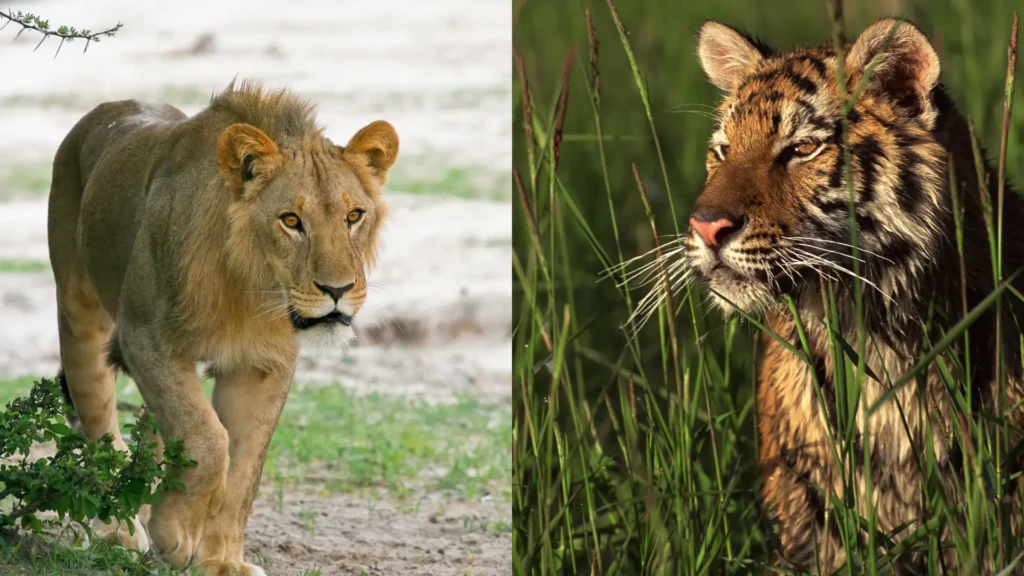
The tiger and the lion are two names that echo with equal majesty across the wild landscapes of Asia and Africa. They are the undisputed royals of the animal world, embodying strength, courage, and dominance. But beneath their shared aura of kingship lies a fascinating contrast, not of strength or size, but of upbringing.
How these two predators are raised, taught, and molded by their mothers and environments determines not only how they hunt, but how they rule. The tiger’s childhood is one of solitude and silence, the lion’s, of community and constant companionship. Both paths lead to power but through very different forests.
Born in Two Worlds
If you wish to trace their destinies, you must first travel to their birthplaces, two worlds as distinct as the creatures themselves.
In the dense jungles of India, where bamboo thickets tangle with shadows and the air hums with monsoon moisture, a tigress withdraws into a secluded den. Her cubs are born blind, tiny bundles of striped fur curled against her warmth. For the first few weeks, the forest barely knew of their existence. She moves them gently from one hidden spot to another, wary of predators even of the scent of men.
Across continents, in the golden savannahs of Africa, a lioness too hides her newborns, but her world is different. The grasslands are open, the horizon endless. Danger can come from anywhere, hyenas, leopards, even rival lions. Here, secrecy lasts only for a few weeks before she introduces the cubs to pride, a society where survival depends on strength in numbers.
Thus begins their journey: one in solitude, the other in social security.

The Protective Mothers
A tigress is a lone warrior, both mother and guardian. Every rustle in the forest, every scent on the wind is a potential threat to her cubs. She hunts quietly and tirelessly, keeping her young hidden until they are strong enough to follow her. When they do, they learn by watching, how she moves with silence, how she stalks unseen, how patience rewards the hunter. Every lesson is personal; every mistake could mean starvation.
In contrast, a lioness does not bear the burden alone. In the pride, mothers share nursing duties, and cubs suckle from any lactating female. They grow up surrounded by siblings, cousins, and guardians. When danger nears, multiple lionesses form a wall of muscle and fury. The cubs learn early the meaning of teamwork, that survival is not a solitary act, but a collective effort.
Play: Nature’s First School
If you’ve ever watched tiger cubs at play, perhaps in the shaded glades of Bandhavgarh or Kanha, you’ll see miniature versions of their mother’s stealth, a sudden pounce, a clumsy stalk, a playful ambush through the tall grass. Every movement, though innocent, is a rehearsal for the solitary life ahead.
Lion cubs, on the other hand, turn the savannah into a playground of strategy and hierarchy. They tumble, chase, wrestle, and roar, always in groups. The stronger ones dominate, the weaker ones learn submission. Through play, they practice social cues, teamwork, and intricate communication that will one day define a pride’s coordinated hunt.

The Fathers: Absent Monarchs and Territorial Guardians
In the tiger’s world, the father’s presence is little more than a rumor. A dominant male may tolerate his cubs within his range, but parenting is a mother’s duty alone, though there are cases reported when father had a parenting duty, but these are on very rare occasion. He defends his territory indirectly, by keeping rival males at bay. For the cubs, he is a distant figure, the scent of dominance that defines the borders of their childhood.
Among lions, the story changes. The pride male or coalition of males is both protector and threat. His rule ensures cub survival, for a new male’s takeover means infanticide. His roars keep intruders away, his presence a living shield. To the cubs, he is a figure of awe sometimes affectionate, sometimes fearsome, but always central to their world. His reign may be short, but his protection is absolute while it lasts.
Learning to Hunt
Around the age of one, tiger cubs begin accompanying their mother on hunts. They learn to stay downwind, to freeze mid-step, to launch themselves with explosive precision. No one teaches them but her, and failure is part of their education. When they finally succeed alone, often after several failed attempts the tigress begins her quiet withdrawal. Her job is nearly done.
Lion cubs learn differently. As they grow, they watch entire groups of lioness’s coordinate circling herds, cutting off escape routes, reading each other’s movements. Hunting is a symphony, not a solo act. Older cubs sometimes join in early, making mistakes but learning through the pride’s rhythm. By the time a lioness leads a full charge, her young already understand the choreography of the kill.

Social vs. Solitary Upbringing
This difference defines their characters forever. The lion, raised in companionship, grows into a social ruler comfortable with hierarchy, power struggles, and cooperation. The tiger, shaped by solitude, becomes a self-reliant monarch, secretive, territorial, and introspective.
A lion’s confidence comes from his pride; a tiger’s from within. The lion’s roar is a declaration of unity, the tiger’s, a command for isolation. The upbringing of each mirrors the ecosystem that nurtures them: the open plains demand cooperation, the dense forest rewards independence.
The Moment of Separation
At around two and a half years old, a tiger’s childhood ends quietly. The mother begins to push her cubs away, sometimes aggressively, until each drift into a neighboring patch of forest to find its own territory. It is a bittersweet goodbye one that marks the beginning of their solitary reigns.
For young lions, the departure is more dramatic. Males are driven out by the dominant pride male to prevent inbreeding, while females often stay. These ousted brothers roam together, forming coalitions, surviving as nomads until they are strong enough to challenge for their own pride. Their journey is long, filled with fights, hunger, and strategy. When they finally claim pride, their childhood lessons in teamwork become their greatest weapon.

In Captivity: Changed Beginnings
In zoos and rescue centers, upbringing takes an unnatural turn. Lion cubs, naturally social, adapt better to group life even in captivity, often seen resting in clusters or playfully grooming one another. Tigers remain more aloof, often preferring solitude even when space is limited. Their instincts, forged by millennia of isolation, rarely fade proof that upbringing is not just nurture, but deep-rooted nature.
Travel Tip: Witnessing the Royal Childhoods
To truly understand how upbringing defines these kings, one must see them where they belong.
In India, head to Bandhavgarh, Ranthambore, or Tadoba, where tigresses raise their young among bamboo groves and rocky ridges. With patience and luck, you might witness a cub trailing behind its mother, eyes full of curiosity and courage.
For lions, journey to Gir National Park in Gujarat, the last home of the Asiatic lion. Here, in the teak-wood hills and open scrublands, lionesses nurture their cubs amid a small but vibrant social circle. Watching a pride at rest, you’ll see generations of royalty, mothers, daughters, and cubs bound by invisible threads of kinship.
Quick Insight: How Upbringing Shapes the Kings of the Wild
Though both are apex predators, their childhood worlds shape them into very different rulers, one molded by solitude, the other by society.
| Aspect | Tiger | Lion |
|---|---|---|
| Habitat at Birth | Dense forests, bamboo thickets, or mangrove jungles – secluded and shaded. | Open grasslands and scrub savannahs – visible, exposed landscapes. |
| Family Structure | Solitary mother: cubs raised alone. | Social group (pride); cubs raised communally. |
| Maternal Care | The tigress hunts, protects, and teaches entirely on her own. | Several lionesses share nursing and guarding duties. |
| Paternal Role | Minimal; male defends territory indirectly but doesn’t raise cubs. | Active protector; dominant male ensures cub safety within the pride. |
| Learning to Hunt | Cubs learn stealth, ambush, and patience through imitation. | Cubs learn teamwork, coordination, and communication. |
| Play Behavior | Solitary play mimics stalking and pouncing for solo hunting. | Group play builds hierarchy, social bonds, and pride cohesion. |
| Socialization | Minimal; cubs interact mainly with mother and siblings. | Constant interaction within the pride; strong social imprinting. |
| Independence Age | 2–3 years; cubs disperse to establish their own territory. | 2 years; males leave pride, females usually stay. |
| Adult Nature | Independent, territorial, secretive, self-reliant. | Social, hierarchical, cooperative, protective. |
| Symbolic Personality | The solitary monarch of the jungle — introspective and self-made. | The crowned ruler of the plains — powerful through unity. |
Two Kings, Two Roads to Majesty

Both the tiger and the lion wear the crown of the wild, yet their paths to the throne could not be more different. One learns in silence, the other in chorus. One rules through solitude, the other through society.
Their upbringings are reflections of the lands they inhabit — the tiger’s forested world demands patience, stealth, and independence; the lion’s open plains reward teamwork, hierarchy, and strength in unity.
And perhaps, that is the true wonder of nature — that even among kings, there is no single path to greatness.
“The tiger learns to be a king in solitude, while the lion is crowned by the pride.”
If you like our blog, please also give a read to Tiger vs Lion: Difference in strength & hunting